This term Year 6 have been consolidating their knowledge of electricity and circuits. They have learned about parallel and series circuits, and drawn diagrams of a range of circuits using the correct symbols for the various components. This week they conducted an experiment to see what happens when the number of cells in a circuit is increased. They noticed how the lightbulb became brighter each time additional cells were added.
Saturday, 31 January 2026
Year 6 Computing
Programming in Scratch
Tuesday, 9 December 2025
Year 6 PE - Boccia
This term in indoor PE, Year 6 have been learning to play Boccia, a sport that is related to bowls. Teams compete to roll their balls closer to the jack than the opposing team's. As it is a Paralympic sport in which competitors are usually in wheelchairs, the children have been playing from a seated position. Each week, children have continued to develop their control and accuracy when rolling the ball. They have thoroughly enjoyed competing against each other in a new sport.
Wednesday, 3 December 2025
Year 6 totem pole sculptures
Year 6 have been learning about the Ancient Maya in history and art. As part of their art learning journey this term, the children explored the work of Canadian artist Robert Davidson, a master carver of totem poles. They learned that 'totem' means 'a natural object or animal that is believed by a particular society to have spiritual significance and that is adopted by it as an emblem'. Having planned and sketched their designs in a previous lesson, children then constructed a wire frame to support their totem poles, before adding clay blocks and using tools to carve facial features and wings.
Tuesday, 23 September 2025
Adjectival agreement in Spanish - Year 6
Year 6 have been working hard to understand how adjectival agreement works in Spanish. They have learnt the rules of feminine/masculine and singular/plural nouns, how these affect the ending of the adjective and how to change and adapt the descriptors and articles so they do make sense in a sentence.
Last week, we had pictures of uniforms from different schools and we had to describe them using the adjectival agreement principle. Children enjoying walking around the classroom talking to their friends in Spanish.
Thursday, 13 March 2025
Year 6 Science - The Circulatory System
Year 6 have been learning about the circulatory system this term. They used a number of common foods and food colourings to create blood samples containing the four main components of blood. They learnt about the roles which red blood cells, white blood cells, platelets and plasma play to keep our bodies healthy. The children also created a blood sample which had fewer than the usual number of red blood cells and a sample which had more than the usual number of white blood cells. In both cases, they explored what the cause of the unusual levels could be and how someone with blood like that might be feeling.
Sunday, 2 March 2025
Year 6 - Immersion Day: Dangerous Places - Geography
This week, Year 6 held an Immersion Day that focused on how places around the Earth can be dangerous through the amount of natural disasters it may experience.
The children learned that tectonic plates and their range of movements, can create a variety of different disasters and changes to the natural world: earthquakes, volcanic eruptions and the formation of mountains being some examples. The children were able to express their movement through an immersive dance lesson; during this lesson the children were able to perform as an erupting volcano and also as if they were in an earthquake. This provided the children an opportunity to act out emotion using the movement of their limbs, musical instruments and facial expressions.
Another highlight of the day was the news reporting lesson. After learning about the different tectonic plate boundaries, Year 6 were tasked to research as case study and provide a news report on it to the rest of the class. Through this lesson, we saw an incredible amount of teamwork come to fruition - from the children helping each other to understand their case studies, to identifying which plate boundary could have been the cause of the disaster, but also carefully considering the impact a natural disaster of such a high magnitude would have on civilians. Some excellent new reporting was done by Year 6, and some awards were given out for the reporting of natural disasters!
After being introduced to tectonic plates and the impact they can have on the natural world, the children put on their seismologist/volcanologist hats to plot out where natural disasters across the world could happen. Through this lesson the children found a pattern that most of these disasters occurred on fault lines and volcanic zones. Posters were made afterwards to warn people about the dangers of natural disasters in these specific areas.
Altogether, Immersion Day was truly a groundbreaking experience for our young geographers! The Year 6 children thoroughly enjoyed the day and it has served as a great introduction to the topic this term.
Sunday, 9 February 2025
Year 6 - Outdoor PE - Jumping
This term, Year 6 have been trialling different skills within athletic sports in their Outdoor PE lessons. A skill that the children were keen to adopt this term was jumping, through the sports of long jump and triple jump.
To provide the children with an optimum strategy for the long jump, Year 6 first practised jumping for height from a stationary position. They were instructed to bend their knees before rising and to bend upon landing, to ensure they were protecting their joints from damage. After a few practice rounds, the children were confident to move on to jumping for distance, ensuring that they used their arms to propel themselves further.
The entire experience was enjoyable, as the children were given the opportunity to beat their personal best in the long jump, but also apply their mathematical skills to measure the distance that was achieved.
Once secure with the long jump, the children were ready to move onto the next lesson in the athletics sequence: triple jump. Before practising, the children learned about the different phases of triple jump (hop, step, jump). Some preferred the simplicity of long jump; the long jump only has one phase (just jump!) while others liked the complexity of the triple jump.
Once again, the metre sticks were out to measure distance and some incredible jumping was achieved by the children of Year 6. Well done to you all!
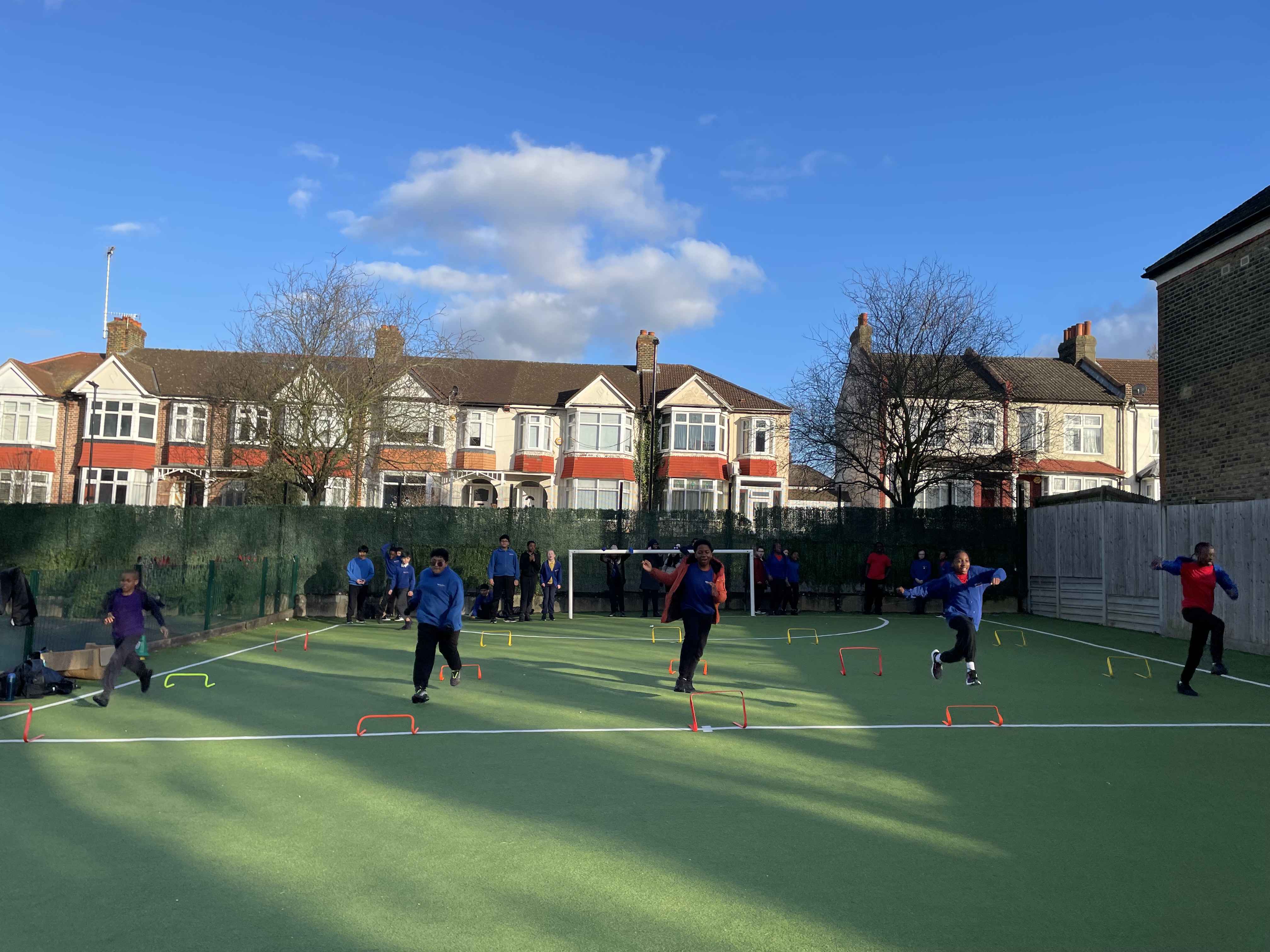
Year 6 - Outdoor PE - Hurdles
The children in Year 6 have started to develop their skills in hurdling this term.
While having an obstacle in front of you when sprinting at full speed can initially be daunting, Year 6 applied a strong focus to strategy and technique. Prior to the hurdles lesson, the children had practised sprinting at full speed, ensuring that they were driving their hips forward and raising their arms up with each stride, all in an effort to quicken their pace.
This lesson, the children applied the same strategy when running towards the hurdle - only this time, there was another strategy needed solely for the hurdles. The children learned that they needed to raise their leading leg (front leg) and keep it extended so that it could reach over the hurdle. While doing so, the back leg (referred to as the trail leg) remained folded and close to the body.
Since the children knew how to safely land when jumping, the priority in the drills was to regain speed once safely on the ground.
The children thoroughly enjoyed the sprinting and hurdling exercises. Using a range of hurdles with different heights also added to the challenge when racing. As a whole, year 6 were extremely cooperative and supportive of each other when running these hurdling races, particularly in the relay race segment of the lesson. It was a joy to watch and it was clear that the children really enjoyed themselves. Please see below for more photos of our athletes tackling the hurdles!
Wednesday, 5 February 2025
Anglo-Saxons in Year 6!
As part of our Crime and Punishment topic, Year 6 have been learning about justice in Anglo-Saxon Britain. The children took part in several interactive activities to discover how criminals were treated in our ancient past and reflected on how crime and punishment had developed since the time of Roman Britain. They were amazed to discover how brutal and unfair the system was in comparison to the justice system we have today.